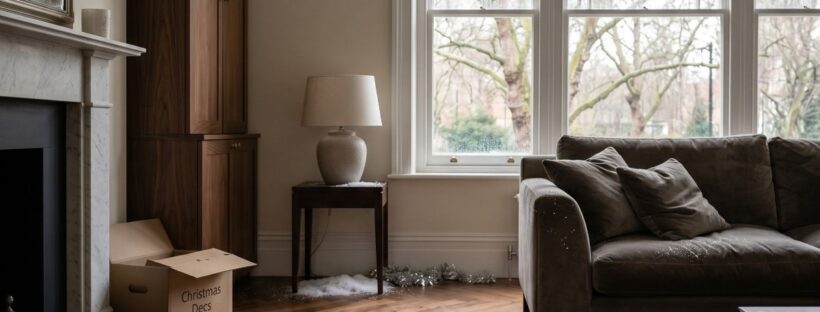
January in Kensington arrives with its own particular atmosphere. The Churchill Arms has taken down its extraordinary floral Christmas display. The Winter Wonderland in Hyde Park has been dismantled with impressive efficiency. The lights along Kensington High Street have come down, the Kensington Palace Gardens residents have presumably un-decked their extraordinary hallways, and the whole neighbourhood has collectively agreed that the festive season is over.
Your home, however, has not received the memo. There is glitter on the kitchen floor that definitely came from a wreath that was never anywhere near the kitchen. The sitting room window still has a faint polymer haze from the spray snow applied in a moment of decorative enthusiasm six weeks ago. Somewhere in the pile of the good rug, a constellation of silver hexagons is waiting to be discovered. And this morning, inexplicably, there was glitter on the bathroom mirror.
The post-Christmas clean is straightforward enough. The post-Christmas glitter and fake snow situation is a different matter entirely, and it deserves its own approach.
Why Glitter and Fake Snow Are Such a Specific Cleaning Nightmare
Understanding why these two substances are so uniquely resistant to standard cleaning makes a genuine difference to how you approach them – and stops you accidentally making the situation considerably worse.
Glitter is manufactured from sheets of reflective material, typically mylar or similar polymers, cut into tiny flat hexagons. These shapes are aerodynamic in precisely the wrong way: light enough to become airborne from the smallest disturbance, flat enough to lie flush against any surface they land on, and electrostatically charged in a way that makes them actively resist removal. They do not sit on top of a carpet fibre – they cling to it. They do not rest on a hard floor – they bond lightly to it via static. And a vacuum cleaner, rather than resolving the problem, creates an air disturbance through its exhaust that sends glitter that was sitting still into circulation again.
Fake snow comes in two primary forms that behave differently and need different solutions. Aerosol spray snow – the kind applied to windows and used to dust over mantlepieces and arrangements – dries as a polymer film that standard glass cleaner does not fully dissolve. Powder or flocked snow, used on artificial trees and in decorative arrangements, is a cellulose-based fibre that compresses into carpets and upholstery with a commitment that outlasts most people’s patience.
Start with the Right Tool – and It Is Almost Certainly Not the Hoover
The instinct to vacuum immediately is understandable and consistently counterproductive where glitter is concerned. Save the vacuum for later in the process, once the majority of glitter has been collected by other means.
The best first tool is tape – wide packing tape or gaffer tape pressed firmly onto the affected surface and lifted cleanly. Work in sections, using a fresh piece of tape each time, pressing it down firmly so the adhesive contacts the surface fully rather than just sitting over the top of the glitter. A lint roller achieves the same effect with more convenience across larger surfaces and is worth keeping specifically for January.
For carpet glitter that has settled into the pile, a piece of Blu-Tack or similar putty adhesive pressed and lifted repeatedly is remarkably effective – it collects the particles without driving them deeper, which a vacuum head at the wrong setting can do. On hard floors, a slightly damp cloth dragged flat along the surface – not wiped in circles, but drawn in one direction – picks up glitter through a combination of static disruption and adhesion without sending it airborne.
Glitter on Hard Floors: The Electrostatic Problem
The beautiful original parquet and encaustic tile floors found in many of Kensington’s Victorian and Edwardian townhouses and mansion flats are, it must be said, a spectacular surface for showing up every last piece of glitter in extraordinary detail. The same gloss that makes them so handsome in a shaft of morning light also contributes to the static charge that holds glitter in place.
Dry sweeping is the wrong first move – a brush creates air disturbance and redistributes glitter rather than collecting it. The correct sequence is tape or damp-cloth collection first, followed by a damp mop once the bulk of the glitter has been gathered, and only then a final vacuum pass to address anything remaining.
For wooden floors, ensure the mop or cloth is genuinely well wrung – enough moisture to disrupt the static and collect the glitter, but not enough to raise the grain of the wood or require an extended drying period. An anti-static floor spray used after cleaning and before the final buff will reduce the rate at which glitter – and ordinary dust – reattaches.
Glitter and Powder Snow in Carpets and Rugs
This is the section for which patience is not a recommendation but a genuine requirement.
The rubber squeegee technique is the most effective method for drawing glitter and fine fibrous particles out of carpet pile, and it is not especially well known outside professional cleaning circles. A clean rubber-bladed squeegee drawn firmly across the carpet in short strokes – as though you were cleaning a window horizontally – creates friction that lifts the carpet fibres and collects particles between them, gathering them into a removable line. Work in sections, collecting and disposing of what accumulates as you go, before following with the lint roller and finally the vacuum.
For deep-pile or wool rugs – and Kensington living rooms tend to have rather good rugs that deserve careful handling – the squeegee method should be used with a lighter touch, working with the pile rather than against it. Powder fake snow in the base of a deep-pile rug may require two or three passes before it is fully extracted, and rushing the process by pressing harder simply embeds it further.
Spray-On Fake Snow on Windows: The January Reckoning
The aerosol fake snow applied to window panes in December – often with genuine artistry, occasionally with rather more enthusiasm than precision – leaves a polymer residue that standard glass cleaner was not designed to address. The result, if treated with glass cleaner alone, is a smeary, streaky haze that can look worse than the original snow effect.
The correct approach starts with warm water and a small amount of washing-up liquid applied with a soft cloth and left to soften the film for two to three minutes before wiping. For residue that does not lift cleanly with this alone, a plastic scraper – never metal, which will scratch glass – held at a shallow angle will remove the film without damaging the pane. The sash windows found throughout Kensington’s period housing are particularly worth treating carefully; the glazing bars and putty surround are not improved by aggressive scraping or excessive moisture.
Follow with a white vinegar and water solution applied with a microfibre cloth for a streak-free finish. Work top to bottom, and do the exterior if accessible – spray snow used from the inside sometimes deposits a fine mist on the outer face as well.
Fake Snow Flocking: The Tree’s Parting Gift
Flocked artificial trees, and the powder snow used to dress real tree branches, leave a specific legacy that is distinct from both spray snow and glitter. The fine cellulose fibres shed continuously throughout December, working their way into surrounding carpet, upholstery, and soft furnishings in a radius that will seem implausible relative to the tree’s actual size.
Once the tree is removed, vacuum the area thoroughly with the upholstery attachment rather than the floor head – the lower suction and softer bristles are more effective at lifting the fibres without driving them deeper. A fine residue of powder snow in carpet can be addressed with a light application of bicarbonate of soda left for twenty minutes before vacuuming, which draws the particles upward and makes them easier to collect.
Any decorative arrangements that used flocking – wreaths, table centrepieces, mantelpiece displays – should be taken outside for their initial shake-down before being packed away, rather than doing their final shedding indoors.
Upholstery and the Glitter That Has Made Itself at Home on the Sofa
Fabric upholstery and glitter have an affinity that reflects no credit on either of them. The electrostatic charge that makes glitter cling to hard floors operates with even more commitment on woven fabric, and the textured surface of most upholstery gives individual particles multiple contact points to bond with.
Tape and lint roller first, pressing firmly and lifting cleanly rather than dragging. For velvet upholstery – present in a significant number of Kensington sitting rooms and entirely unforgiving of the wrong approach – use tape only, lifting straight up rather than at an angle, and work in the direction of the pile. The damp rubber glove technique works well on plain fabric: a rubber washing-up glove barely dampened, rubbed lightly across the surface, collects glitter and fibres through friction and static disruption in a way that is satisfying out of all proportion to the effort involved.
Dark Clothing: The Festive Season’s Final Insult
Dark coats, jumpers, and trousers in December are essentially functioning as glitter collection devices, and anyone who has arrived home from a Winter Wonderland visit, a Kensington Christmas party, or simply a sitting room that has been living with a glittery wreath for three weeks will be familiar with the situation.
A lint roller is the most immediate solution and should be used before any attempt to brush or shake the garment, which simply redistributes the glitter further into the fabric. For anything that has been through the washing machine – where glitter migrates to every other item in the drum with cheerful indiscretion – a cold wash with a half-cup of white vinegar added helps to release the particles from fibres. A mesh laundry bag used to contain the worst-affected items protects everything else in the load.
The Long Game: Why Glitter Keeps Reappearing Until March
No honest account of post-Christmas glitter removal would be complete without acknowledging the temporal dimension of the problem. Glitter does not leave all at once. It leaves in waves, over weeks, as residual particles are disturbed from locations that were not initially identified as affected.
This is not a cleaning failure. It is a property of the material, which is light enough to travel on the slight air movements created by opening doors, switching on heating, and simply moving through a room. A systematic room-by-room approach in the first two weeks of January – working through each space with the tape, rubber, and damp-cloth sequence before vacuuming – removes the primary deposits. What follows in February and occasionally into March is a maintenance operation: the lint roller kept accessible, the damp cloth used routinely, and a certain equanimity about the piece of silver glitter that will inevitably be found on a bathroom shelf in August, a small and glittering remnant of the previous December.